
The Tooling
Why general-purpose AI cannot build n8n workflows reliably, and how n8n-mcp and n8n-skills close the gap — with a clear separation between build time and run time.
This page explains how the pipeline gets built and why the approach is reliable. If you are only interested in what gets built, skip to the pipeline design.
Why general-purpose AI cannot build these workflows reliably
n8n — the automation platform this pipeline runs on — has a library of several thousand building blocks, called nodes. Each one has its own set of parameters, its own operations, and its own quirks, and the library changes with every release.
Ask a general-purpose AI assistant to build an n8n workflow and it answers from memory. That produces confident, plausible, wrong output: node names that do not exist, parameters in the wrong shape, configurations that were valid two releases ago. The failure is not carelessness — it is what happens whenever a model recalls detail about a large, fast-moving library instead of looking it up.
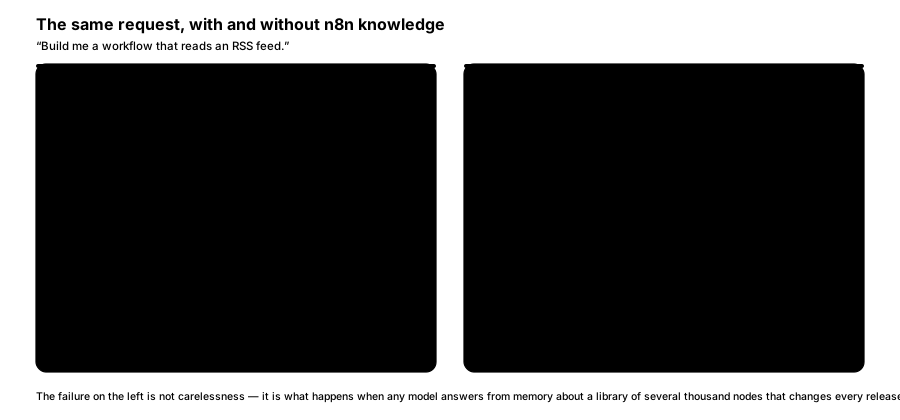
FIGURE 2 — The same request, with and without n8n knowledge.
The practical cost is that errors surface late — when the workflow runs against real systems — and get fixed by trial and error against a live site. The two tools described below exist to move that discovery to build time.
n8n-mcp — giving the AI real knowledge of n8n
n8n-mcp is an open-source MCP server. MCP — Model Context Protocol — is a standard way of giving an AI assistant access to tools and data. In this case, the data is n8n itself.
The single most important thing to understand about it is that it operates in two separate modes.
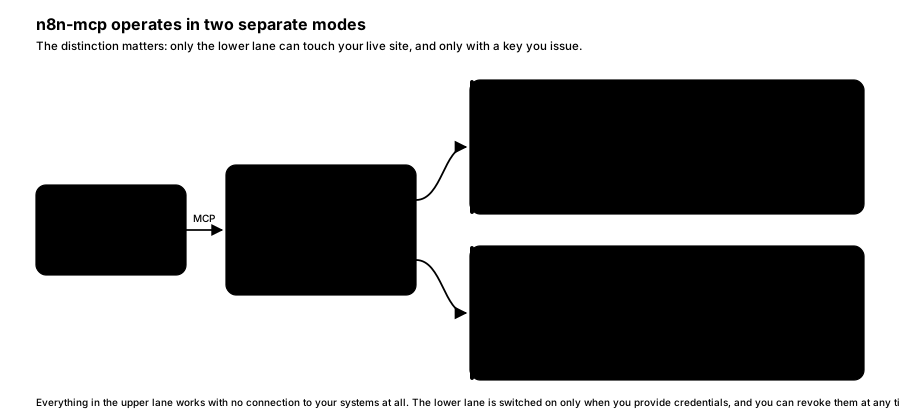
FIGURE 3 — n8n-mcp operates in two separate modes.
Reference mode works entirely offline. A database of the n8n node library ships with the server — every node's properties and operations, the official documentation, and a large library of proven workflow templates. Answering "which node reads an RSS feed, and what parameters does it take?" requires no credentials and no connection to any of your systems.
Management mode acts on a live n8n instance — creating workflows, running them, inspecting what happened, rolling back. This mode exists only when you supply an n8n API key, and it does nothing until you do. You issue that key, and you can revoke it.
That separation is the security story in one line: the vast majority of the work happens against a local reference database, and the part that touches your systems is gated behind a credential you control.
What that gives the AI, concretely
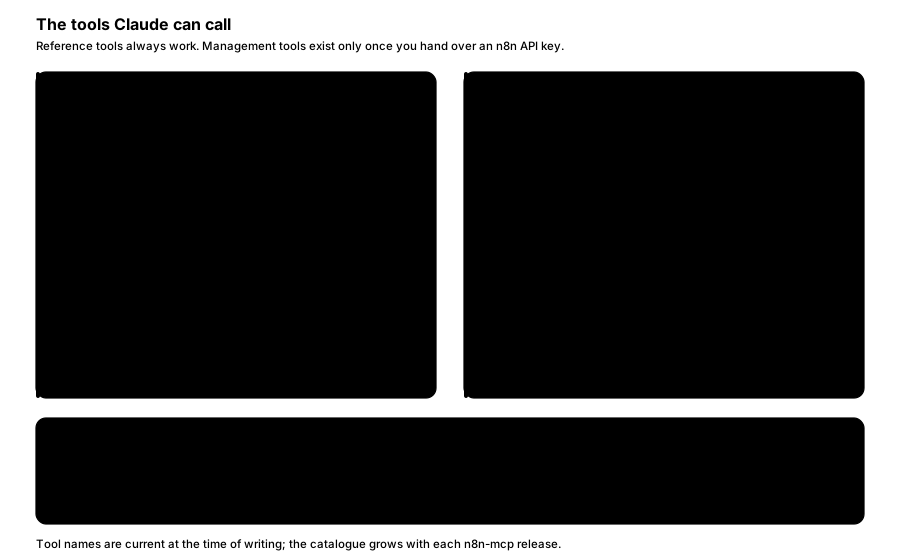
FIGURE 4 — The tools Claude can call.
The reference tools answer questions: find me a node for this job, what does this node actually require, is this configuration valid, is this whole workflow valid, is there a proven template for this. The management tools act: create this workflow, change this one part of it, run it, show me what happened, roll it back.
Two details matter more than they might appear to:
get_nodehas detail levels. Asking forminimal,standardorfullcontrols how much comes back. Requesting the least that answers the question keeps the AI's attention on the problem rather than on pages of irrelevant configuration.validate_nodehas strictness profiles —minimal,runtime,ai-friendly,strict. A workflow can be checked loosely while being drafted and strictly before deployment.
Tool names and counts here are current at the time of writing. The catalogue grows with each release.
n8n-skills — teaching correct practice on top
Knowing every node is not the same as knowing how to build well. n8n-skills is a companion set of Claude Code skills: focused instruction sets, each covering one area of n8n practice, that load when the task calls for them.
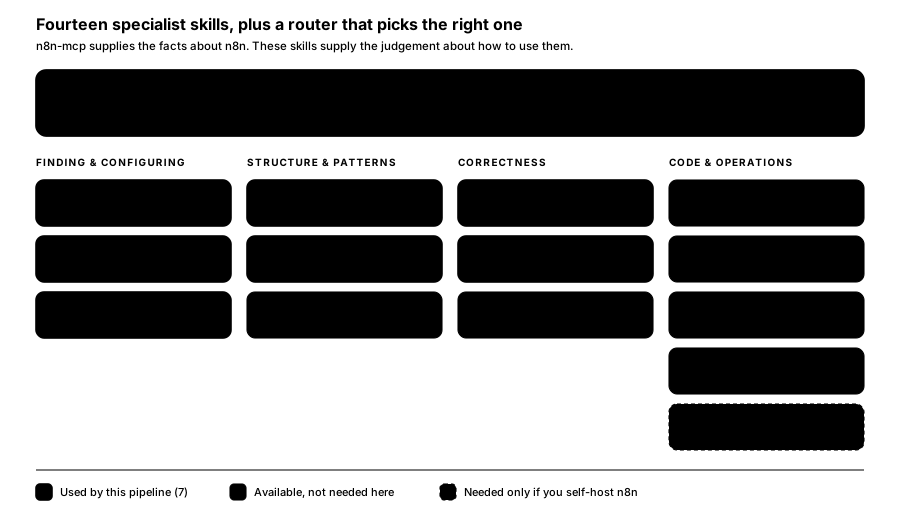
FIGURE 5 — Fourteen specialist skills, plus a router.
Fourteen specialist skills sit behind an always-on router that loads at the start of every session and directs attention to whichever ones the current task needs. Seven of them bear directly on this pipeline:
| Skill | Why it matters here |
|---|---|
n8n-mcp-tools-expert | Using the reference tools efficiently rather than flailing |
n8n-workflow-patterns | This pipeline is two of its documented patterns combined — a scheduled task and an AI agent workflow |
n8n-node-configuration | Which fields each node operation actually requires |
n8n-expression-syntax | Passing data correctly between the source, the writer and the website |
n8n-agents | Configuring the AI writer, its prompt, and its human review |
n8n-validation-expert | Interpreting validation output and fixing the real problem |
n8n-error-handling | What the pipeline does when a source disappears or your site refuses a post |
The remaining seven cover ground this pipeline does not touch — writing code inside workflows, handling binary files, splitting work into sub-workflows, managing multiple n8n servers. One, n8n-self-hosting, becomes relevant only if you host n8n yourself (see decision 9).
How the guidance actually gets used
Skills only help if they are read at the right moment. n8n-skills ships a small enforcement layer that makes sure they are.
FIGURE 6 — Guidance that arrives at the moment of the decision.
The mechanism is worth one paragraph because it explains why this is more reliable than documentation sitting in a folder. Guidance is injected at the moment of the decision, not hoped for in advance: a reminder fires as a node is looked up, and after a workflow is validated a hook reads the node types the workflow actually contains and pulls in the matching skills. The layer is additive only — if anything inside it fails, the tool call proceeds regardless. It can supply guidance; it can never withhold or block.
Build time versus run time
This is the point most often misunderstood, so it is worth stating plainly.
FIGURE 7 — The toolchain builds it. n8n runs it.
n8n-mcp and n8n-skills are used to build the workflow. They are not part of the running system. Once the pipeline is deployed, it runs on n8n alone, on your schedule, talking to your sources and your website. There is no ongoing dependency on Claude, on the MCP server, or on the team that built it. If the entire toolchain disappeared tomorrow, your pipeline would keep running exactly as before.
The toolchain returns only when you want to change something — and any change goes through the same validation as the original build.
How is this guide?
Last updated on
AI-Native Content Automation Pipeline
A reference design for an automated content pipeline that watches your sources, drafts articles with AI, and files them for human approval — built on n8n, n8n-mcp and n8n-skills.
The Pipeline, Prescribed
The prescribed design — decisions to lock before building, then the three automated stages: watch the sources, draft the article, file it as a draft for approval.