
Core Concepts
Foundation concepts of the Netspective Unified Process - 7 phases, 24 disciplines, activities, and artifacts
The Netspective Unified Process (NUP) is built on a foundation of well-defined concepts from the Unified Method Architecture (UMA). Understanding these core concepts is essential for effectively applying the methodology to your regulated software development projects.
Overview
NUP organizes software development around several key structural elements:
| Concept | Description |
|---|---|
| Phase | Seven distinct stages: Strategy, Envision, Inception, Elaboration, Construction, Transition, Production |
| Discipline | 24 disciplines covering engineering, operations, compliance, security, and business |
| Activity | A unit of work that roles perform, forming breakdown structures |
| Artifact | Formal work products that are version-controlled |
How Concepts Relate
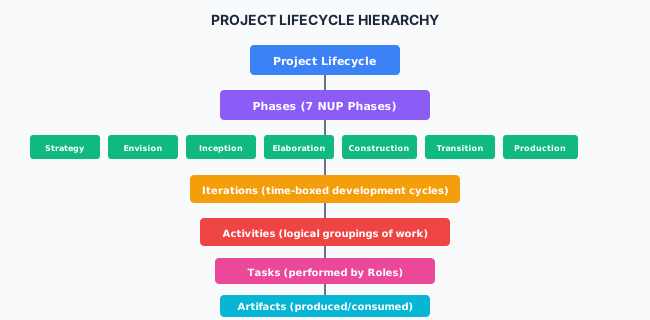
Disciplines Across Phases
NUP's 24 disciplines span across all phases:
| Category | Disciplines |
|---|---|
| Core Engineering | Requirements, Design, Coding & Implementation, Testing, Integration |
| Operations | Deployment & Maintenance, Configuration Management, Infrastructure, DevOps, SecDevOps |
| Architecture & Strategy | Enterprise Architecture, Project Strategy, Project Management |
| Compliance & Security | Regulatory & Legal Compliance, Information Assurance & Security |
| Business & Growth | User Experience, User Onboarding, Marketing, Media Relations, Client Communication, Sales, Growth Hacking |
| Advanced Tech | Data Science, Machine Learning |
The UMA Foundation
NUP is based on the Unified Method Architecture (UMA), a state-of-the-art architecture for conceiving, specifying, and storing method and process metadata. UMA provides:
- Separation of Concerns: Method content (what to do) is separated from process (when and how to do it)
- Reusability: Content elements can be reused across different processes
- Flexibility: Processes can be tailored to specific project needs
- Traceability: Clear relationships between elements enable audit trails
Key Principles
Iterative & Incremental Development
Rather than following a rigid waterfall approach, NUP divides work into iterations:
- Each iteration produces a working build of the system
- Early iterations focus on reducing risk and establishing architecture
- Later iterations focus on building out functionality
- Every iteration provides feedback for improvement
Role-Based Responsibility
Work is organized around roles rather than individuals:
- Roles define expected behaviors and responsibilities
- One person may fulfill multiple roles
- Multiple people may share a single role
- Roles are assigned to tasks and activities
Artifact-Centric Tracking
All work produces tangible outputs:
- Artifacts are version-controlled for traceability
- Artifacts serve as inputs and outputs to tasks
- Artifact states indicate project progress
- Templates ensure consistency across projects
Getting Started
- Understand Phases - Learn how projects progress through distinct lifecycle stages
- Know Your Disciplines - Identify the areas of concern relevant to your work
- Follow Activities - Execute the right tasks at the right time
- Produce Artifacts - Create the documentation and deliverables your project needs
Related Resources
Compliance
This section fulfills ISO 13485 requirements for general QMS requirements (4.1), documentation (4.2.1), QMS planning (5.4.2), planning of product realization (7.1), and design and development (7.3), and ISO 27001 requirements for security policies (A.5.1), security roles (A.5.2), information security in project management (A.5.8), and documented procedures (A.5.37).
How is this guide?
Last updated on
Netspective Unified Process for Deterministic Software
An agile quality system and SDLC for regulated IT deliverables. Meet FDA, HIPAA, NIST, and FedRAMP requirements with audit-ready documentation and modern engineering practices.
Phases
Understanding the seven phases of the NUP lifecycle for regulated software development