
Templates
Ready-to-use templates for architecture, project management, QA, and requirements
Templates provide standardized starting points for common documentation needs. They ensure consistency across projects and help teams capture the right information in a structured format.
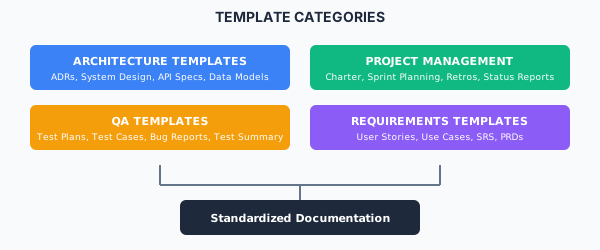
Template Categories
Benefits of Using Templates
| Benefit | Description |
|---|---|
| Consistency | Same format across all projects and teams |
| Efficiency | Don't start from scratch each time |
| Completeness | Prompts ensure nothing is missed |
| Quality | Best practices built into structure |
| Compliance | Templates aligned with regulatory needs |
Available Templates
Architecture Templates
| Template | Purpose | When to Use |
|---|---|---|
| ADR Template | Document architecture decisions | Major technical decisions |
| System Design Doc | Overall system architecture | New systems, major changes |
| API Specification | API contract documentation | API development |
| Data Model | Database schema documentation | Data design |
Project Management Templates
| Template | Purpose | When to Use |
|---|---|---|
| Project Charter | Project authorization | Project kickoff |
| Sprint Planning | Sprint scope and goals | Sprint planning |
| Retrospective | Team improvement | End of sprint |
| Status Report | Progress communication | Weekly/bi-weekly |
QA Templates
| Template | Purpose | When to Use |
|---|---|---|
| Test Plan | Testing strategy | Before testing phase |
| Test Case | Individual test steps | Test development |
| Bug Report | Defect documentation | Bug discovery |
| Test Summary | Testing results | After testing phase |
Requirements Templates
| Template | Purpose | When to Use |
|---|---|---|
| User Story | Feature requirements | Backlog creation |
| Use Case | Detailed interactions | Complex workflows |
| SRS | Formal requirements | Regulated projects |
| PRD | Product features | Product planning |
Template Usage Guidelines
Customization
Templates should be adapted to your project's needs:
- Start with the template - Don't reinvent the wheel
- Add project-specific sections - Include what's unique
- Remove irrelevant sections - Don't include empty sections
- Maintain core structure - Keep essential elements
Version Control
templates/
├── architecture/
│   ├── adr-template.md
│   ├── system-design-template.md
│   └── api-spec-template.md
├── project-management/
│   ├── project-charter-template.md
│   ├── sprint-planning-template.md
│   └── retrospective-template.md
├── qa/
│   ├── test-plan-template.md
│   ├── test-case-template.md
│   └── bug-report-template.md
└── requirements/
    ├── user-story-template.md
    ├── use-case-template.md
    └── srs-template.md
Template Governance
- Assign template owners
- Review and update templates periodically
- Gather feedback from users
- Align with process changes
- Track template versions
Regulated Industry Templates
For FDA, HIPAA, SOX, and other regulated environments:
| Document | Requirement | Template Location |
|---|---|---|
| Requirements Spec | FDA 820.30 | Requirements Templates |
| Design Spec | FDA 820.30 | Architecture Templates |
| Test Protocol | FDA 820.30 | QA Templates |
| Traceability Matrix | FDA 820.30 | Requirements Templates |
| Risk Analysis | ISO 14971 | Architecture Templates |
| Validation Protocol | FDA 820.30 | QA Templates |
Related Resources
- Architecture Templates
- Project Management Templates
- QA Templates
- Requirements Templates
- Microsoft Playbook: Engineering Documentation
Compliance
This section fulfills ISO 13485 requirements for control of documents (4.2.3), control of records (4.2.4), design planning (7.3.2), design inputs (7.3.3), design outputs (7.3.4), and design verification (7.3.6), and ISO 27001 requirements for documented procedures (A.5.37), documented information (A.7.5), secure development lifecycle (A.8.25), secure architecture (A.8.27), and secure coding (A.8.28).
How is this guide?
Last updated on