
Activities
Understanding activities as building blocks of process execution
An activity is something that one or more roles do. Activities support the nesting and logical grouping of related process elements, forming the hierarchical breakdown structures that organize project work.
What is an Activity?
In the Unified Method Architecture (UMA), an activity is a breakdown element that:
- Groups related work together
- Can contain sub-activities (nesting)
- References tasks through descriptors
- Forms the building blocks of processes
An activity is a breakdown element which supports the nesting and logical grouping of related process elements such as descriptors and sub-activities, thus forming breakdown structures.
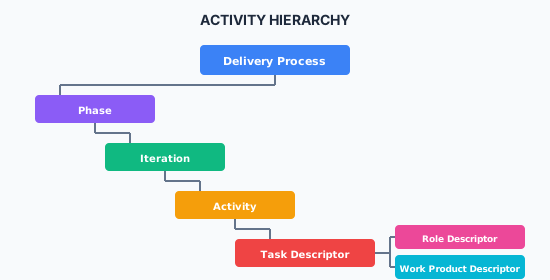
Activity Hierarchy
Activities organize work in a hierarchical structure:
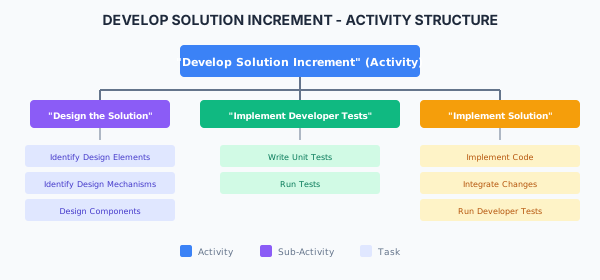
Example: Development Activity Structure
Activities vs Tasks
| Aspect | Activity | Task |
|---|---|---|
| Scope | Container for work | Unit of work |
| Granularity | Coarse-grained | Fine-grained |
| Nesting | Can contain sub-activities | Cannot be nested |
| Duration | Multiple hours to days | Hours |
| Performers | Multiple roles | Typically one role |
NUP Activities by Phase
NUP defines specific activities for each of its seven phases. Each activity contains tasks that roles perform to produce artifacts.
1. Strategy Phase Activities
Define Project
- Conduct Market Research
- Initial Project Scoping
Define OKR
- Identify and Document Objectives and Key Results (OKRs)
- Align OKRs with Business Goals
Plan and Manage Iteration
- Plan Iteration
- Manage Iteration
2. Envision Phase Activities
Develop Intellectual Property Strategy
- IP Assessment and Planning
Define and Establish Architecture Capability
- Define and Establish Enterprise Architecture Team
- Confirm Governance and Support Frameworks
- Identify and Establish Architecture Principles
- Implement Architecture Tools
- Scope Enterprise Organizations Impacted
- Tailor Architecture Framework
Develop Architecture Vision
- Establish Architecture Project
- Identify Stakeholders, Concerns, and Business Requirements
- Confirm and Elaborate Business Goals, Drivers, and Constraints
- Evaluate Business Capabilities
- Assess Readiness for Business Transformation
- Define Scope
- Develop Architecture Vision
- Identify Business Transformation Risks and Mitigation Activities
Develop Business Architecture
- Select Reference Models, Viewpoints, and Tools
- Develop Baseline Business Architecture Description
- Develop Target Business Architecture Description
- Perform Gap Analysis
- Define Candidate Roadmap Components
- Resolve Impacts Across Architecture Landscape
- Conduct Formal Stakeholder Review
- Finalize Business Architecture
- Create Architecture Definition Document
Develop Data Architecture
- Data Architecture Development Tasks
Develop Application Systems Architecture
- Application Architecture Development Tasks
Develop Technology Architecture
- Technology Architecture Development Tasks
Generate Architecture Roadmap
- Roadmap Planning and Documentation
Develop Migration Plan
- Migration Strategy Development
Manage Architecture Change
- Architecture Change Management
Establish Implementation Governance
- Governance Framework Implementation
3. Inception Phase Activities
Initiate Project
- Plan Project
- Initial Planning Activities
Plan and Manage Iteration
- Plan Iteration
- Manage Iteration
Understand User Experience
- Understand Users and Their Needs
- Identify User Personas
- Use Customer Journey Maps
Identify and Detail Requirements
- Find and Outline Requirements
- Detail Requirements
- Create Test Cases
Ensure DevOps Involvement
- Involve DevOps Team Early
- Initial Infrastructure Planning
4. Elaboration Phase Activities
Identify and Detail Requirements
- Find and Outline Requirements (expanded)
- Detail Requirements
- Create Test Cases
Plan and Manage Iteration
- Plan Iteration
- Manage Iteration
Develop the Architecture
- Outline the Architecture
- Refine the Architecture
Develop Solution Increment
- Design the Solution
- Implement the Solution
- Code Review
- Implement Developer Tests
- Run Developer Tests
- Integrate and Create Build
- Create Style Guide
Test Solution
- Implement Test Scripts
- Integrate
- Run Tests
Ongoing Tasks
- Request Change
- Ensure Artifact Versioning
5. Construction Phase Activities
Identify and Detail Requirements
- Find and Outline Requirements
- Detail Requirements
- Create Test Cases
Plan and Manage Iteration
- Plan Iteration
- Manage Iteration
Develop Solution Increment
- Create a Style Guide
- Design the Solution
- Ensure DevOps Involvement
- Implement the Solution
- Code Review
- Implement Developer Tests
- Run Developer Tests
- Integrate and Create Build
Test Solution
- Implement Test Scripts
- Integrate and Create Build
- Run Tests
Ongoing Tasks
- Request Change
- Ensure Artifact Versioning
6. Transition Phase Activities
Plan and Manage Iteration
- Plan Iteration
- Manage Iteration
Develop Solution Increment
- Design the Solution
- Ensure DevOps Involvement
- Implement Developer Tests
- Implement the Solution
- Code Review
- Run Developer Tests
- Integrate and Create Build
Test Solution
- Implement Test Scripts
- Integrate and Create Build
- Run Tests
- Software Validation
Set up the Demo Environment
- Create and Update Demo Environment
Ongoing Tasks
- Request Change
- Ensure Artifact Versioning
Plan for Deployment and Release
- Plan Project (deployment-focused)
7. Production Phase Activities
Handle the Move into Production
- Ensure DevOps Involvement
- Maintenance
Plan and Manage Iteration
- Plan Iteration
- Manage Iteration
Activity Categories
Iteration Activities
Activities that recur each iteration:
- Plan Iteration
- Manage Iteration
- Development Work
- Iteration Review
- Retrospective
- Assess Results
Cross-Phase Activities
Activities that span multiple phases:
- Plan and Manage Iteration
- Request Change
- Ensure Artifact Versioning
- Quality Planning
Milestone Activities
Activities focused on milestone achievement:
- Milestone Preparation
- Milestone Review
- Milestone Assessment
- Go/No-Go Decision
Activity Descriptors
Activities reference content elements through descriptors. A descriptor is an abstract generalization that references one concrete content element, enabling separation of process from method content.
Why Descriptors?
- Reusability: Same task can be used in different activities
- Customization: Process can modify how a task is performed
- Flexibility: Different projects can use tasks differently
Descriptor Properties
| Property | Description |
|---|---|
| Multiple Occurrences | Can occur more than once in the process |
| Optional | May be skipped based on project needs |
| Planned | Included in project planning |
Breakdown Structures
Activities form breakdown structures - hierarchical decompositions of work:
Work Breakdown Structure (WBS)
Organizes work by deliverable:
Product
    └── Component A
        └── Feature 1
            └── Design Feature 1
            └── Implement Feature 1
            └── Test Feature 1
Team Allocation Structure
Organizes work by team:
Development Team
    ├── Backend Development
    │   └── API Development Activity
    └── Frontend Development
        └── UI Development Activity
Responsibility Assignment
Maps roles to activities:
Activity: "Design Solution"
    ├── Responsible: Software Architect
    ├── Accountable: Technical Lead
    ├── Consulted: Business Analyst
    └── Informed: Project Manager
Activity Patterns
Capability Pattern
A reusable activity structure that can be applied in different processes:
Example: "Develop Component"
- Can be used in any phase
- Includes standard tasks for development
- Customizable per project
Delivery Process
A complete process with all activities defined:
- Includes all phases
- Defines activity sequence
- Specifies milestones
Planning Activities
Iteration Planning Process
- Review Backlog: Identify candidate work items
- Estimate Effort: Size tasks within activities
- Allocate Resources: Assign roles to activities
- Define Acceptance: Specify done criteria
- Commit to Plan: Team agreement on iteration scope
Activity Estimation
| Activity Type | Typical Duration | Estimation Approach |
|---|---|---|
| Design | 1-3 days | Expert judgment |
| Implementation | 2-5 days | Story points |
| Testing | 1-2 days | Test case count |
| Review | 2-4 hours | Artifact size |
Tracking Activity Progress
Activity States
| State | Description |
|---|---|
| Not Started | Activity not yet begun |
| In Progress | Activity actively being worked |
| Blocked | Activity cannot proceed |
| Complete | Activity finished and verified |
Progress Indicators
- Task Completion: % of tasks done
- Artifact Completion: % of artifacts produced
- Test Passing: % of tests passing
- Review Status: Approvals obtained
Best Practices
Activity Definition
- Keep activities focused and cohesive
- Define clear entry and exit criteria
- Identify dependencies between activities
- Estimate realistically
Activity Execution
- Work on one activity at a time when possible
- Complete activities before starting new ones
- Track blockers immediately
- Communicate progress daily
Activity Review
- Review completed activities promptly
- Document lessons learned
- Update estimates based on actuals
- Improve activity definitions
Related Resources
Compliance
This section fulfills ISO 13485 requirements for planning of product realization (7.1), control of production (7.5.1), and monitoring and measurement (8.2.4), and ISO 27001 requirements for documented procedures (A.5.37) and information security in project management (A.5.8).
How is this guide?
Last updated on