
Automated Testing
Comprehensive testing strategies for regulated software - unit, integration, E2E, and performance testing
Automated testing is a cornerstone of quality software development, especially in regulated environments where testing evidence must be preserved for audits. This section covers the testing pyramid, best practices, and compliance considerations for each testing level.
Why Automated Testing Matters
In regulated software development, testing serves dual purposes:
- Quality assurance: Ensure the software works correctly and safely
- Compliance evidence: Provide documented proof of verification activities
Code is incomplete without tests. Write unit tests that are small and fast. Test where it makes sense, not just to hit 100% coverage.
The Testing Pyramid
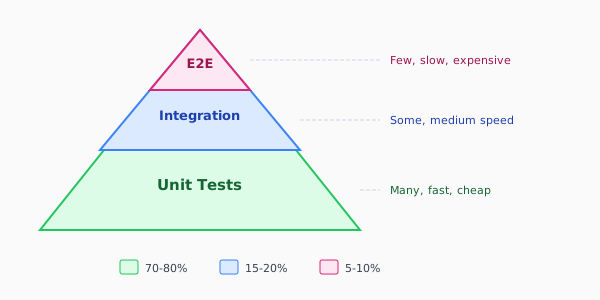
| Level | Quantity | Speed | Cost | Scope |
|---|---|---|---|---|
| Unit Tests | Many (70-80%) | Fast (ms) | Low | Individual functions/classes |
| Integration | Some (15-20%) | Medium (s) | Medium | Component interactions |
| E2E | Few (5-10%) | Slow (min) | High | Full system flows |
Core Testing Principles
1. Test First Mentality
Write tests before or alongside implementation, not as an afterthought:
- TDD (Test-Driven Development): Write failing tests first, then implement
- BDD (Behavior-Driven Development): Write tests as specifications
- Specification by Example: Use examples as test cases
2. Arrange-Act-Assert Pattern
Structure tests consistently:
// Arrange: Set up test data and conditions
const user = createTestUser({ role: 'admin' });
const document = createTestDocument({ status: 'draft' });

// Act: Execute the code under test
const result = await documentService.publish(document, user);

// Assert: Verify the expected outcome
expect(result.status).toBe('published');
expect(result.publishedBy).toBe(user.id);
3. F.I.R.S.T. Principles
| Principle | Description |
|---|---|
| Fast | Tests should run quickly (milliseconds for unit tests) |
| Independent | Tests should not depend on other tests |
| Repeatable | Same result every time, in any environment |
| Self-validating | Pass or fail, no manual interpretation |
| Timely | Written at the right time (with or before code) |
Testing in Regulated Environments
Compliance Requirements
For FDA, HIPAA, and other regulatory frameworks:
| Requirement | How Testing Addresses It |
|---|---|
| Verification | Automated tests verify implementation matches requirements |
| Traceability | Tests linked to requirements in traceability matrix |
| Documentation | Test results provide objective evidence |
| Repeatability | Automated tests are repeatable and consistent |
| Change Control | Test failures catch regression from changes |
Test Documentation
For regulated software, document:
- Test Plan: Strategy, scope, and approach
- Test Cases: Individual test specifications
- Test Results: Execution records with pass/fail status
- Traceability Matrix: Requirements linked to tests
Traceability Example
Requirement: REQ-AUTH-001 - User must authenticate before accessing PHI

Test Cases:
├── TC-AUTH-001: Valid login grants access
├── TC-AUTH-002: Invalid password denies access
├── TC-AUTH-003: Locked account denies access
└── TC-AUTH-004: Session timeout requires re-authentication

Code Implementation:
└── src/auth/AuthService.authenticate()
Test Coverage
What to Measure
| Metric | Description | Target |
|---|---|---|
| Line Coverage | % of lines executed | 70-80% |
| Branch Coverage | % of conditional branches | 70-80% |
| Function Coverage | % of functions called | 90%+ |
| Requirement Coverage | % of requirements tested | 100% |
Coverage Guidance
- Don't chase 100%: Focus on critical paths and risk areas
- Quality over quantity: Better to have meaningful tests than many trivial ones
- Risk-based testing: Higher coverage for safety-critical code
- Exclude boilerplate: Generated code, simple getters/setters may be excluded
Coverage Example Configuration
// jest.config.js
module.exports = {
  collectCoverageFrom: [
    'src/**/*.{js,ts}',
    '!src/**/*.d.ts',
    '!src/**/*.test.{js,ts}',
    '!src/generated/**',
  ],
  coverageThreshold: {
    global: {
      branches: 70,
      functions: 80,
      lines: 80,
      statements: 80,
    },
    './src/core/**': {
      branches: 90,
      functions: 90,
      lines: 90,
    },
  },
};
Test Organization
Directory Structure
project/
├── src/
│   ├── components/
│   │   ├── Button.tsx
│   │   └── Button.test.tsx      # Co-located unit tests
│   └── services/
│       ├── AuthService.ts
│       └── AuthService.test.ts
├── tests/
│   ├── integration/              # Integration tests
│   │   └── auth.integration.test.ts
│   ├── e2e/                      # End-to-end tests
│   │   └── login.e2e.test.ts
│   └── fixtures/                 # Test data
│       └── users.json
└── coverage/                     # Coverage reports
Naming Conventions
| Type | Convention | Example |
|---|---|---|
| Unit Test | *.test.ts or *.spec.ts | Button.test.tsx |
| Integration | *.integration.test.ts | auth.integration.test.ts |
| E2E | *.e2e.test.ts | login.e2e.test.ts |
| Test Utilities | test-utils.ts | test-utils.ts |
Continuous Integration
Test Execution in CI/CD
# GitHub Actions example
name: Tests
on: [push, pull_request]

jobs:
  test:
    runs-on: ubuntu-latest
    steps:
      - uses: actions/checkout@v4

      - name: Install dependencies
        run: npm ci

      - name: Run unit tests
        run: npm run test:unit -- --coverage

      - name: Run integration tests
        run: npm run test:integration

      - name: Upload coverage
        uses: codecov/codecov-action@v3

      - name: Check coverage thresholds
        run: npm run test:coverage-check
Test Execution Order
- Pre-commit: Fast unit tests (lint-staged)
- PR/Push: Full unit test suite
- PR/Push: Integration tests
- Nightly/Deploy: Full E2E suite
- Weekly: Performance tests
Testing Best Practices
Do
- Write tests for all new code
- Include tests in code reviews
- Run tests locally before pushing
- Keep tests fast (unit tests < 100ms each)
- Use meaningful test descriptions
- Test edge cases and error conditions
- Mock external dependencies appropriately
Don't
- Skip tests to meet deadlines
- Write tests that depend on execution order
- Test implementation details (test behavior)
- Mock too much (test real integration when possible)
- Ignore flaky tests (fix or remove them)
- Write tests that sleep/wait arbitrarily
Testing Tools Ecosystem
JavaScript/TypeScript
| Category | Tools |
|---|---|
| Unit Testing | Jest, Vitest, Mocha |
| Assertions | Jest matchers, Chai |
| Mocking | Jest mocks, Sinon |
| E2E | Playwright, Cypress, Puppeteer |
| API Testing | Supertest, MSW |
| Coverage | Istanbul/NYC, c8 |
Other Languages
| Language | Unit | Integration | E2E |
|---|---|---|---|
| Python | pytest, unittest | pytest | Selenium, Playwright |
| Java | JUnit, TestNG | Spring Test | Selenium |
| C# | xUnit, NUnit | ASP.NET TestServer | Selenium, Playwright |
| Go | testing package | testify | Selenium |
Related Resources
- Unit Testing
- Integration Testing
- E2E Testing
- Performance Testing
- Test Automation
- Code Reviews
- Microsoft Playbook: Automated Testing
Compliance
This section fulfills ISO 13485 requirements for design verification (7.3.6), design validation (7.3.7), process validation (7.5.6), product monitoring (8.2.4), and control of records (4.2.4), and ISO 27001 requirements for security testing (A.8.29), secure development lifecycle (A.8.25), secure architecture (A.8.27), and compliance verification (A.5.36).
How is this guide?
Last updated on