
Code Reviews
Code review practices for improving code quality, knowledge sharing, and team collaboration
Code reviews are a critical practice for maintaining code quality, sharing knowledge, and building team cohesion. This section covers the complete code review process from the Microsoft Engineering Playbook.
Why Code Reviews?
Code reviews serve three primary purposes:
- Improve code quality by catching defects early
- Facilitate learning through exposure to different patterns and approaches
- Build shared understanding across the development team
Peer code reviews on every pull request (or check-in to a shared branch) should be standard practice, with reviews functioning as collaborative conversations rather than gatekeeping mechanisms.
Core Principles
Quality Over Speed
- Don't rush reviews
- Catch issues before they reach production
- Reviews are an investment, not overhead
Collaborative, Not Adversarial
- Reviews are conversations, not critiques
- Focus on the code, not the person
- Assume good intent
Learning Opportunity
- Share knowledge through reviews
- Explain the "why" behind suggestions
- Welcome questions
Topics in This Section
Pull Request Process
How to create and manage effective pull requests:
- Author responsibilities
- Reviewer responsibilities
- PR templates
- Merge criteria
Review Checklists
What to look for during code reviews:
- Functionality and code quality
- Security (OWASP-aligned)
- Input validation, error handling, logging
- Performance and SAST integration
Language Recipes
Language-specific review guidance:
- TypeScript/JavaScript
- Python
- C#
- Go
Quick Start
For Authors
- Keep PRs small and focused
- Write clear descriptions
- Self-review before requesting review
- Respond to feedback constructively
For Reviewers
- Review promptly (within 24 hours)
- Be specific and constructive
- Approve when good enough (not perfect)
- Ask questions instead of making demands
Review Workflow
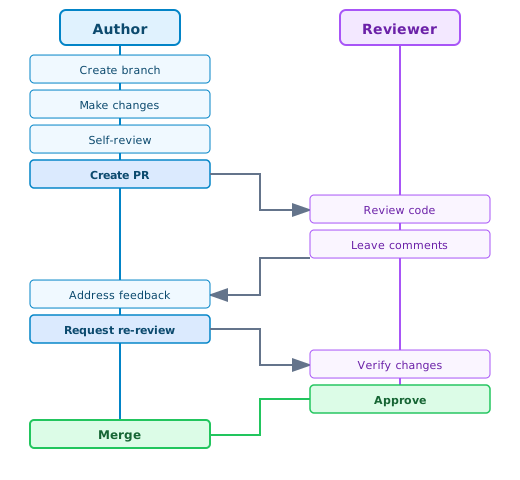
Metrics
Key Metrics to Track
| Metric | Target | Why It Matters |
|---|---|---|
| Review turnaround | < 24 hours | Keeps work flowing |
| PR size | < 400 lines | Enables thorough review |
| Comments per PR | 2-5 | Indicates engagement |
| Approval rate | > 90% first review | Shows PR quality |
What NOT to Measure
- Lines reviewed per hour (encourages rushing)
- Defects found (encourages nitpicking)
- Rejection rate (discourages thorough review)
Common Anti-Patterns
Rubber Stamping
Problem: Approving without actually reviewing Fix: Require substantive comments or explicit "reviewed, no issues found"
Nitpicking
Problem: Focusing on style over substance Fix: Use automated linting; focus on meaningful issues
Large PRs
Problem: 1000+ line PRs that can't be reviewed effectively Fix: Enforce PR size limits; break work into smaller chunks
Slow Reviews
Problem: PRs sitting for days without review Fix: Set SLAs; include review time in planning
Adversarial Tone
Problem: Comments that feel like attacks Fix: Training on constructive feedback; lead by example
Code Review in Regulated Environments
For FDA, HIPAA, FedRAMP compliance:
Documentation Requirements
- PR linked to work item/requirement
- Review comments preserved
- Approval recorded with identity
- Timestamp of review captured
Additional Review Criteria
- Security implications considered
- Audit trail maintained
- Compliance requirements verified
- Risk assessment updated if needed
Tools
PR Templates
Use templates to ensure consistent information:
- Description of changes
- Testing performed
- Screenshots (for UI changes)
- Checklist items
Automation
Automate what you can:
- Linting and formatting
- Test execution
- Security scanning
- Documentation generation
Review Tools
- GitHub PR reviews
- Azure DevOps pull requests
- GitLab merge requests
- Reviewable
- CodeStream
Best Practices Summary
Authors Should
- Self-review before requesting review
- Keep PRs focused and small
- Provide context in descriptions
- Respond promptly to feedback
Reviewers Should
- Review within 24 hours
- Be specific and constructive
- Approve when requirements are met
- Follow up on comments
Teams Should
- Set clear expectations (DoD, review criteria)
- Track and improve review metrics
- Automate style and format checks
- Foster psychological safety
Related Resources
- Team Agreements
- Automated Testing
- Microsoft Playbook: Code Reviews
- Google's Engineering Practices: How to do a code review
- OWASP Code Review Guide
- OWASP Cheat Sheet Series
Compliance
This section fulfills ISO 13485 requirements for software validation (4.1.5), control of records (4.2.4), design review (7.3.5), design verification (7.3.6), and monitoring and measurement (8.2.4), and ISO 27001 requirements for secure development lifecycle (A.8.25), application security requirements (A.8.26), secure coding (A.8.28), security testing (A.8.29), and information security in project management (A.5.8).
How is this guide?
Last updated on