
Management Roles
Project management and stakeholder roles in NUP
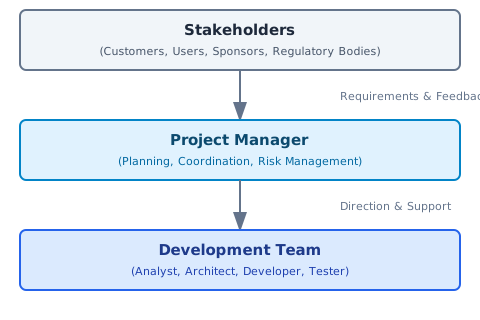
Management roles in NUP are responsible for planning, coordinating, and overseeing the project. These roles ensure that the project delivers value to stakeholders while managing risks and resources effectively.
Management Role Structure
Project Manager
The Project Manager leads the planning of the project in collaboration with stakeholders and team, coordinates interactions with stakeholders, and keeps the project team focused on meeting the project objectives.
Overview
The Project Manager is also responsible for evaluating which regulatory compliances are most applicable for their projects, making this role crucial in NUP's compliance-focused methodology.
Primary Responsibilities
- Coach the team to drive successful project outcomes
- Accountable for project outcome and customer acceptance
- Evaluate and control project risks through mitigation strategies
- Apply management knowledge, skills, tools, and techniques
- Ensure DevOps involvement throughout the project
- Evaluate applicable regulatory compliance requirements
Tasks
| Task | Description |
|---|---|
| Plan Project | Create and maintain the overall project plan |
| Plan Iteration | Define iteration objectives and work items |
| Manage Iteration | Coordinate daily activities and remove blockers |
| Assess Results | Evaluate iteration outcomes and project health |
| Ensure DevOps Involvement | Coordinate with operations team |
Additional Tasks
- Define Vision
- Outline the Architecture
- Refine the Architecture
Artifacts
| Artifact | Purpose |
|---|---|
| Project Plan | Overall project approach, schedule, and resources |
| Iteration Plan | Detailed plan for current iteration |
| Risk List | Identified risks and mitigation strategies |
| Work Items List | Prioritized list of work to be completed |
Skills Required
Essential Skills:
- Leadership and team building capabilities
- Thorough experience in the software development lifecycle
- Proficient in conflict resolution and problem solving
- Good presentation, facilitation, and communication
- Strong negotiation skills
NUP-Specific Skills:
- Understanding of regulatory compliance frameworks
- Knowledge of risk management techniques
- Experience with agile methodologies
Assignment Approaches
This role is often played by a single person. The role is difficult to share with others but might not consume all of a person's availability on smaller projects.
Compliance Responsibilities
The Project Manager must evaluate and ensure compliance with applicable regulations:
| Compliance | Applicability |
|---|---|
| HIPAA | Healthcare data projects |
| PCI-DSS | Payment card handling |
| SOX | Financial reporting systems |
| FISMA | Federal information systems |
| GLBA | Financial institution data |
| 508 | Federal accessibility requirements |
| Basel II | Banking risk management |
| EU Data Protection | European data handling |
| SB 1386 | California data breach notification |
| BS 7799 | Information security management |
Project Manager Activities by Phase
| Phase | Primary Focus |
|---|---|
| Strategy | Define OKRs, initial project scoping |
| Envision | Establish governance, stakeholder identification |
| Inception | Initial planning, team formation |
| Elaboration | Refine plans, manage architectural risks |
| Construction | Iteration management, progress tracking |
| Transition | Deployment planning, stakeholder sign-off |
| Production | Handoff, maintenance planning |
Stakeholder
The Stakeholder represents interest groups whose needs must be satisfied by the project. This role may be played by anyone who is (or potentially will be) materially affected by the outcome of the project.
Overview
Stakeholders include customers, end users, sponsors, regulatory bodies, and anyone with a vested interest in the project outcome. Their involvement is critical to project success.
Types of Stakeholders
| Type | Interest |
|---|---|
| Customer | Business sponsor who funds the project |
| End User | People who will use the system |
| Sponsor | Executive who champions the project |
| Subject Matter Expert | Domain knowledge provider |
| Regulatory Body | Compliance requirements |
| Operations | System maintenance and support |
| Security | Security and risk requirements |
Participation in Tasks
Stakeholders may participate in various project tasks:
| Task | Stakeholder Involvement |
|---|---|
| Assess Results | Review and approve deliverables |
| Create Test Cases | Provide acceptance criteria |
| Define Vision | Articulate business needs |
| Design the Solution | Validate design decisions |
| Detail Requirements | Clarify requirements |
| Find and Outline Requirements | Express needs and goals |
| Implement Test Scripts | Acceptance test input |
| Manage Iteration | Prioritize work items |
| Outline the Architecture | Validate architectural direction |
| Plan Iteration | Approve iteration goals |
| Plan Project | Set project direction |
Stakeholder Engagement Model
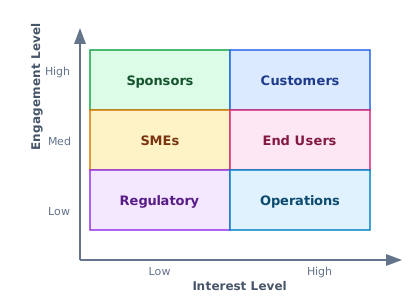
Stakeholder Communication Matrix
| Stakeholder | Communication Method | Frequency |
|---|---|---|
| Sponsor | Status reports, steering committee | Weekly/Bi-weekly |
| Customer | Demos, reviews | Each iteration |
| End User | Demos, usability testing | As needed |
| SME | Requirements sessions | During analysis |
| Regulatory | Compliance reviews | At milestones |
| Operations | Handoff meetings | Transition phase |
Management Role Interactions
Responsibility Matrix (RACI)
| Activity | PM | Stakeholder | Team |
|---|---|---|---|
| Project Planning | R/A | C | C |
| Risk Management | R/A | I | C |
| Iteration Planning | R | A | C |
| Daily Coordination | R | I | A |
| Progress Reporting | R | I | C |
| Milestone Reviews | R | A | C |
| Change Management | R | A | C |
Legend: R = Responsible, A = Accountable, C = Consulted, I = Informed
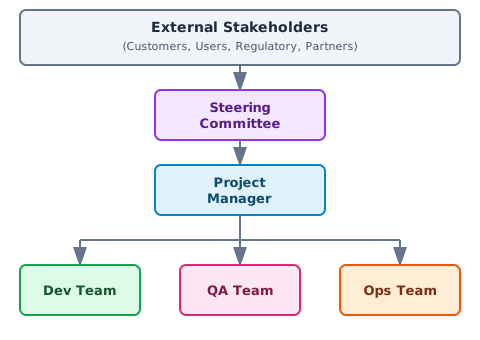
Communication Flow
Management Practices
Project Planning
The Project Manager is responsible for creating and maintaining plans that guide the project:
Project Plan Contents:
- Project scope and objectives
- Lifecycle and phase approach
- Schedule and milestones
- Resource allocation
- Risk management approach
- Communication plan
- Quality approach
Iteration Plan Contents:
- Iteration objectives
- Work items to be completed
- Team assignments
- Risks and mitigation
- Dependencies
Risk Management
| Risk Category | Management Approach |
|---|---|
| Technical | Architecture spikes, prototypes |
| Schedule | Buffer time, prioritization |
| Resource | Cross-training, backup plans |
| Requirements | Frequent validation, iteration |
| Compliance | Early assessment, expert review |
Metrics and Reporting
| Metric | Purpose |
|---|---|
| Velocity | Team productivity trend |
| Burndown | Progress toward iteration goals |
| Defect Density | Quality indicator |
| Risk Exposure | Risk management effectiveness |
| Stakeholder Satisfaction | Value delivery |
Best Practices
For Project Managers
Planning:
- Involve the team in planning
- Keep plans lightweight and adaptable
- Focus on near-term detail, long-term direction
Communication:
- Maintain transparency with stakeholders
- Hold regular status meetings
- Document decisions and rationale
Risk Management:
- Identify risks early
- Address highest risks first
- Review risks regularly
Team Support:
- Remove blockers promptly
- Shield team from distractions
- Celebrate successes
For Stakeholder Engagement
Involvement:
- Engage stakeholders early and often
- Set clear expectations for participation
- Respect stakeholders' time
Communication:
- Tailor communication to audience
- Use demos over documents
- Provide regular progress updates
Feedback:
- Create easy channels for feedback
- Act on feedback visibly
- Close the loop on decisions
Phase-Specific Management Activities
Strategy Phase
- Define project scope with stakeholders
- Establish OKRs
- Identify key risks
- Initial resource planning
Envision Phase
- Stakeholder identification
- Governance establishment
- Architecture vision alignment
Inception Phase
- Detailed project planning
- Team formation
- Initial risk assessment
- Iteration 0 planning
Elaboration Phase
- Risk-driven planning
- Architecture validation
- Requirements prioritization
- Mid-project health check
Construction Phase
- Iteration management
- Progress tracking
- Change management
- Quality monitoring
Transition Phase
- Deployment planning
- User acceptance coordination
- Stakeholder sign-off
- Training coordination
Production Phase
- Handoff to operations
- Lessons learned
- Project closure
- Success metrics review
Related Resources
Compliance
This section fulfills ISO 13485 requirements for management responsibility (5.1), management representative (5.5.2), and resource management (6.1), and ISO 27001 requirements for leadership (5.1), roles and responsibilities (A.5.2), and information security in project management (A.5.8).
How is this guide?
Last updated on