
Agile Development
Agile practices for effective software delivery - backlog management, ceremonies, team agreements, and collaboration
Agile development emphasizes iterative delivery, continuous feedback, and adaptive planning. This section combines NUP's structured lifecycle approach with modern agile practices from the Microsoft Engineering Playbook.
Core Philosophy
"Individuals and interactions over documents and processes" — while maintaining shared accountability through accessible tools and clear communication structures.
The key principles are:
- Iterative delivery: Ship working software frequently
- Customer collaboration: Engage stakeholders throughout
- Responding to change: Adapt to new information
- Working software: Measure progress by what's delivered
Agile in Regulated Environments
Agile doesn't mean "no documentation." In regulated software (FDA, HIPAA, FedRAMP), agile practices coexist with compliance requirements:
| Agile Value | Regulated Adaptation |
|---|---|
| Working software over documentation | Working software with required documentation |
| Responding to change | Controlled changes with audit trails |
| Customer collaboration | Stakeholder + compliance officer involvement |
| Individuals and interactions | Defined roles with documented responsibilities |
Topics in This Section
Backlog Management
How to maintain and prioritize your product backlog:
- Writing effective user stories
- Prioritization techniques
- Minimal slices
- External feedback integration
Ceremonies
The rituals that keep agile teams aligned:
- Sprint planning
- Daily standups
- Sprint reviews
- Retrospectives
Team Agreements
Shared understanding that enables collaboration:
- Definition of Done
- Definition of Ready
- Working agreements
- Team manifesto
Collaboration
Practices for effective teamwork:
- Pair programming
- Virtual collaboration
- Async communication
- Knowledge sharing
Key Practices
Shared Backlog Accessibility
All team members should have access to the backlog and understand:
- What work is planned
- What's in progress
- What's blocked
- What's complete
Iteration-Based Planning
Work is organized into time-boxed iterations:
- Fixed duration (typically 1-4 weeks)
- Committed scope
- Demonstrable outcomes
- Regular checkpoints
Transparent Progress Tracking
Progress is visible to all stakeholders:
- Burndown/burnup charts
- Velocity tracking
- Impediment logs
- Status dashboards
Continuous Improvement
Teams regularly reflect and adapt:
- Retrospectives after each iteration
- Action items tracked to completion
- Process experiments encouraged
- Metrics inform decisions
Agile Roles
| Role | Responsibility |
|---|---|
| Product Owner | Defines priorities, accepts deliverables |
| Scrum Master | Facilitates process, removes impediments |
| Development Team | Delivers working software |
| Stakeholders | Provide requirements, feedback |
Integration with NUP Phases
Agile iterations occur within NUP phases:
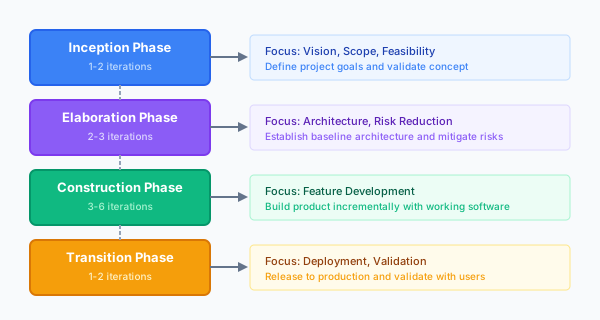
Metrics That Matter
Velocity
- Story points completed per iteration
- Used for planning, not performance evaluation
- Should stabilize over time
Cycle Time
- Time from start to done for a work item
- Indicates flow efficiency
- Target: consistent and short
Lead Time
- Time from request to delivery
- Indicates overall responsiveness
- Includes wait time
Quality Metrics
- Defect escape rate
- Test coverage
- Code review completion
Getting Started
- Establish your iteration cadence (1-4 weeks)
- Create your initial backlog with prioritized items
- Define your team agreements (DoD, DoR)
- Set up your ceremonies schedule
- Start iterating and improve continuously
AI-Era Adaptations
Modern teams may adopt:
- Lightweight planning and validation over rigid cadences
- AI-assisted tools while maintaining human oversight
- Continuous delivery instead of iteration-based releases
- Trunk-based development with feature flags
Related Resources
Compliance
This section fulfills ISO 13485 requirements for QMS planning (5.4.2), planning of product realization (7.1), customer communication (7.2.3), design planning (7.3.2), and monitoring and measurement (8.2.3), and ISO 27001 requirements for information security in project management (A.5.8), documented operating procedures (A.5.37), secure development lifecycle (A.8.25), and change management (A.8.32).
How is this guide?
Last updated on