
Architecture Decisions
Architecture Decision Records (ADRs) for documenting significant design decisions
Architecture Decision Records (ADRs) are documents that capture important architectural decisions along with their context and consequences. They provide a historical record of why decisions were made and serve as valuable documentation for current and future team members.
What is an ADR?
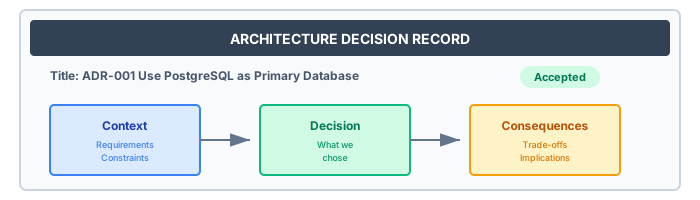
An Architecture Decision Record documents:
- Context: The situation and forces at play
- Decision: What was decided
- Consequences: The results of the decision
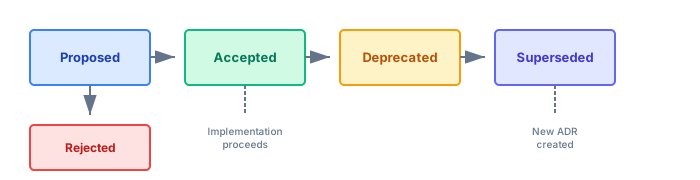
- Status: Current state (proposed, accepted, deprecated, superseded)
Why Use ADRs?
| Benefit | Description |
|---|---|
| Historical Context | Understand why decisions were made |
| Onboarding | Help new team members learn the system |
| Consistency | Ensure aligned decision-making |
| Compliance | Document decisions for auditors |
| Reversibility | Know what to reconsider when conditions change |
ADR Template
# ADR-[NUMBER]: [TITLE]

## Status

[Proposed | Accepted | Deprecated | Superseded by ADR-XXX]

## Context

[Describe the situation, the problem, and the forces at play.
What is the issue that we're seeing that is motivating this decision?]

## Decision

[Describe the decision and the approach we're taking.
State the decision clearly and concisely.]

## Consequences

### Positive
- [List positive outcomes]

### Negative
- [List negative outcomes and trade-offs]

### Risks
- [List risks that this decision introduces]

## Alternatives Considered

### Alternative 1: [Name]
- Description: [Brief description]
- Pros: [Advantages]
- Cons: [Disadvantages]
- Reason not chosen: [Why this wasn't selected]

### Alternative 2: [Name]
[Same structure as above]

## Related Decisions

- [Links to related ADRs]

## References

- [Links to relevant documentation, articles, or resources]

## Notes

[Any additional context, meeting notes, or discussion points]

---

**Date:** [YYYY-MM-DD]
**Author:** [Name]
**Reviewers:** [Names]
Example ADRs
ADR-001: Use React for Frontend Framework
# ADR-001: Use React for Frontend Framework

## Status
Accepted

## Context
We need to select a frontend framework for our patient portal application.
The application requires:
- Complex interactive UI components
- Real-time updates
- Accessibility compliance (508)
- Strong TypeScript support
- Large ecosystem for healthcare-related components

Our team has experience with both Angular and React.

## Decision
We will use React with TypeScript for the frontend application.

## Consequences

### Positive
- Large talent pool for hiring
- Extensive component libraries available
- Strong TypeScript integration
- Flexible architecture decisions
- Active community and long-term support

### Negative
- Need to make additional architecture decisions (state management, routing)
- JSX learning curve for developers new to React
- More boilerplate compared to newer frameworks

### Risks
- React ecosystem fragmentation (many ways to do things)
- Potential for inconsistent patterns across teams

## Alternatives Considered

### Alternative 1: Angular
- Pros: Full framework with opinions, TypeScript-first
- Cons: Steeper learning curve, smaller talent pool
- Reason not chosen: Team has more React experience

### Alternative 2: Vue.js
- Pros: Gentle learning curve, good documentation
- Cons: Smaller ecosystem, fewer healthcare libraries
- Reason not chosen: Smaller talent pool in our market

## Related Decisions
- ADR-002: State Management with Redux Toolkit
- ADR-003: Component Library Selection

## References
- React documentation: https://react.dev
- Healthcare UI components: [internal wiki link]

---
Date: 2024-01-15
Author: Jane Smith
Reviewers: John Doe, Alice Johnson
ADR-002: Database Selection for Audit Logs
# ADR-002: Immutable Audit Log Storage

## Status
Accepted

## Context
Our HIPAA-compliant application requires comprehensive audit logging with:
- Immutability (logs cannot be modified or deleted)
- High write throughput
- Long-term retention (7 years)
- Query capability for compliance reporting
- Cost-effective storage

## Decision
We will use a tiered approach:
1. Amazon Kinesis for real-time ingestion
2. S3 with Object Lock for immutable storage
3. Athena for ad-hoc queries
4. OpenSearch for operational queries (90-day window)

## Consequences

### Positive
- True immutability with S3 Object Lock
- Cost-effective long-term storage
- Scalable write throughput
- Flexible query options

### Negative
- More complex architecture
- Multiple services to maintain
- Query latency for historical data

### Risks
- AWS vendor lock-in
- Need expertise in multiple services
- Cost management for high-volume logs

## Alternatives Considered

### Alternative 1: Single database (PostgreSQL)
- Pros: Simple, familiar
- Cons: No true immutability, expensive at scale
- Reason not chosen: Cannot guarantee immutability

### Alternative 2: Blockchain-based logging
- Pros: True immutability, tamper-evident
- Cons: Complex, expensive, overkill for use case
- Reason not chosen: Unnecessary complexity

---
Date: 2024-01-20
Author: Bob Wilson
Reviewers: Security Team, DBA Team
ADR Lifecycle
Status Definitions
| Status | Description |
|---|---|
| Proposed | Under discussion, not yet decided |
| Accepted | Decision made, guides implementation |
| Deprecated | No longer applies, but kept for history |
| Superseded | Replaced by a newer decision |
| Rejected | Proposed but not accepted |
When to Write an ADR
Write an ADR when making decisions about:
- Technology Selection: Frameworks, languages, databases
- Architecture Patterns: Microservices vs monolith, event-driven
- Integration Approaches: How systems communicate
- Security Mechanisms: Authentication, authorization approaches
- Data Management: Storage, caching, replication strategies
- Infrastructure: Cloud providers, deployment strategies
- Compliance: How to meet regulatory requirements
Decision Significance Test
Ask yourself:
- Will this decision be hard to reverse?
- Will it affect multiple components or teams?
- Will new team members need to understand why?
- Could this decision be questioned by auditors?
If yes to any, write an ADR.
ADR Organization
File Naming Convention
docs/
└── architecture/
    └── decisions/
        ├── 0001-use-postgresql-for-primary-database.md
        ├── 0002-implement-event-sourcing.md
        ├── 0003-select-react-for-frontend.md
        └── README.md (index of all ADRs)
Index File
# Architecture Decision Records

| ADR | Title | Status | Date |
|-----|-------|--------|------|
| [ADR-001](0001-use-postgresql.md) | Use PostgreSQL | Accepted | 2024-01-10 |
| [ADR-002](0002-event-sourcing.md) | Implement Event Sourcing | Accepted | 2024-01-15 |
| [ADR-003](0003-react-frontend.md) | Select React for Frontend | Accepted | 2024-01-20 |
ADR Review Process
Before Meeting
- Author drafts ADR with proposed decision
- Distribute to stakeholders
- Collect initial feedback asynchronously
During Review
- Present context and forces
- Explain proposed decision
- Discuss alternatives
- Address concerns
- Reach consensus or defer
After Review
- Update ADR with final decision
- Change status to Accepted/Rejected
- Commit to repository
- Communicate decision to broader team
Compliance Benefits
Regulatory Traceability
| Regulation | ADR Support |
|---|---|
| FDA QSR | Design decisions documented in Design History File |
| HIPAA | Security architecture decisions recorded |
| SOC 2 | Control implementation decisions documented |
| ISO 27001 | Information security decisions tracked |
Audit Evidence
ADRs provide auditors with:
- Evidence of deliberate decision-making
- Documentation of alternatives considered
- Risk awareness and mitigation
- Traceability to requirements
Best Practices
Do
- Write ADRs early, before implementation
- Keep ADRs concise and focused
- Include the date and authors
- Link to related decisions
- Update status when decisions change
- Store ADRs in version control with code
Don't
- Write ADRs retroactively (unless necessary)
- Let ADRs become stale
- Make them too long or detailed
- Skip the alternatives section
- Forget to communicate decisions
- Delete old ADRs (deprecate instead)
Tools
| Tool | Description |
|---|---|
| adr-tools | CLI for managing ADRs |
| Log4brains | ADR management with web UI |
| Markdown | Simple, version-controlled |
| Confluence | Wiki-based with templates |
adr-tools Example
# Initialize ADR directory
adr init docs/architecture/decisions

# Create new ADR
adr new "Use PostgreSQL for primary database"

# Supersede an ADR
adr new -s 2 "Use TimescaleDB for time-series data"

# Generate table of contents
adr generate toc > docs/architecture/decisions/README.md
Related Resources
- Design Overview
- Design Reviews
- Design Patterns
- Microsoft Playbook: Design Reviews
- ADR GitHub Organization
Compliance
This section fulfills ISO 13485 requirements for design and development outputs (7.3.4), design review records (7.3.5), and control of records (4.2.4), and ISO 27001 requirements for secure architecture (A.8.27), documented operating procedures (A.5.37), and change management (A.8.32).
How is this guide?
Last updated on